
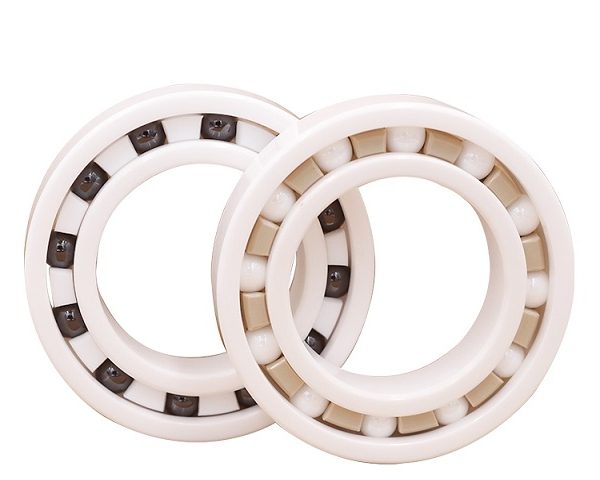
ceramic bearing
ceramic bearing
- Description
- Inquiry
Ceramic bearings
Application drives everything of a bearing, this is why ceramic is used to substitute for steel material in making a bearing. A ceramic bearing generally means its rolling elements (balls) is made of ceramic, or the entire bearing is by ceramic. When a bearing comprises both steel and ceramic materials, it is named hybrid bearing, while the bearing contains ceramic material only, it is called a full ceramic bearing. Common materials for ceramic bearings include ZrO2, Si3N4, 99.5% Al2O3 and SiC.
Why ceramic bearing is currently available only in ball type instead of roller types? It could be answered by explaining how a ceramic bearing is produced. Exactly ceramic bearings are powder made bearings, all their rolling surfaces are directly grinded to the designed accuracy levels. They couldn’t be turned on lath like steel bearings due to the poor ductility, however a roller definitely requires turning process as it has regular sharp edges.
Features of hybrid ceramic bearing
- Free of lubricating
- Insulation
- Less weight
- Low thermal conduction
- Medium corrosion resistance
- Proof of magnetic conduction
Features of full ceramic bearing
- Free of lubricating
- Less weight
- Magnetic free
- Proof of electrical conduction
- High and low temperature resistance
- Corrosion resistance
- Contaminant durability
- Low thermal conduction
Available ceramic bearing types and sizes at KIHOI
- Ceramic insert ball bearing: bore 12mm ~ 100mm
- Ceramic deep groove ball bearing: bore 3mm ~ 110mm
- Ceramic angular contact ball bearing: bore 10mm ~ 200mm
- Ceramic self-aligning ball bearing: bore 12mm ~ 105mm
- Ceramic thrust ball bearing: bore 3mm ~ 220mm